Autoguider in PINS · free and open source
Predictive guiding
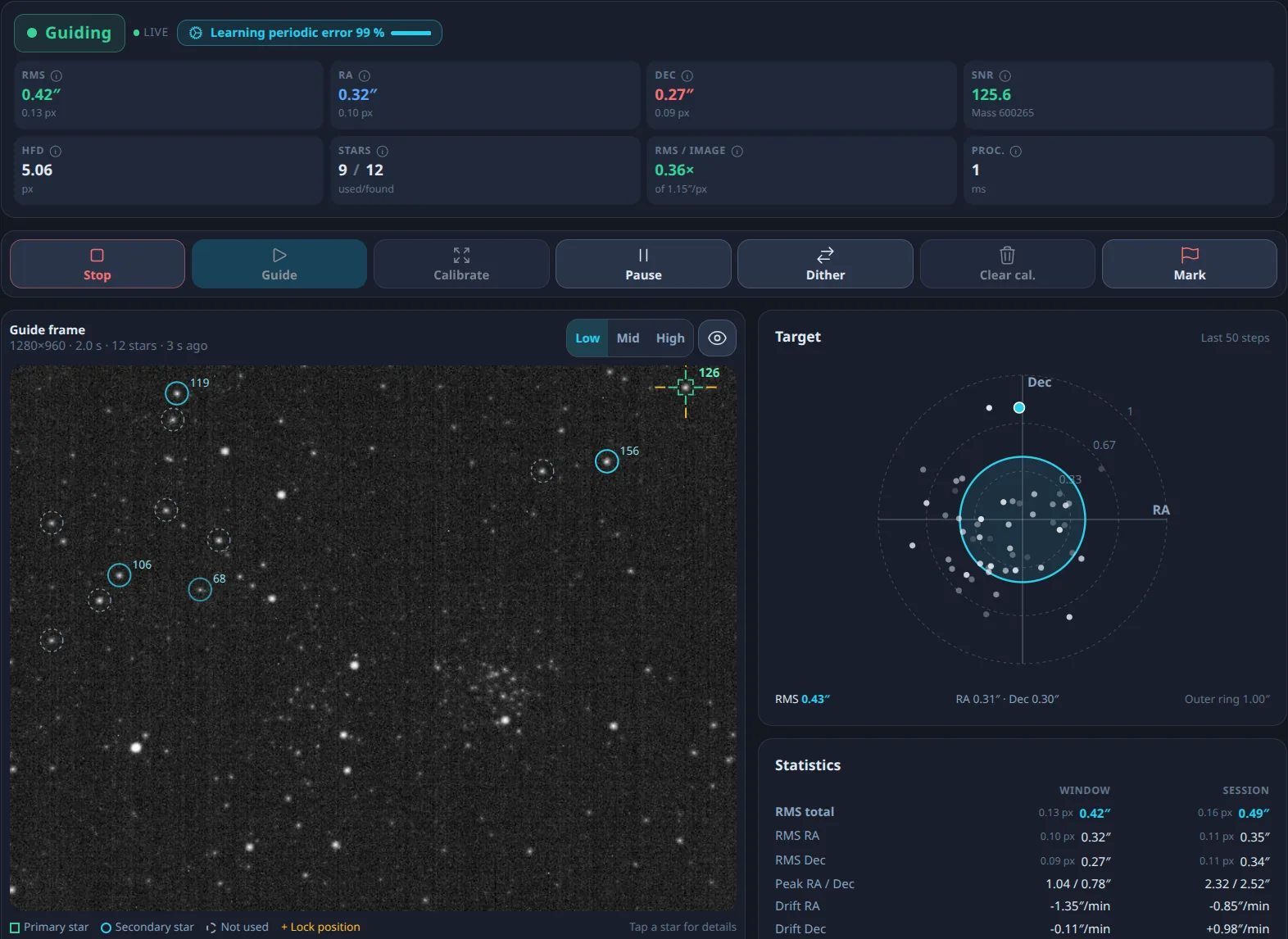
One of my contributions to PINS is its built-in autoguider. It ports PHD2's star detection, multi-star guiding and calibration, and adds a predictive algorithm that learns how the mount and the night behave.
PINS brings N.I.N.A. to Linux and the Raspberry Pi, free and open source, from the people behind Touch-N-Stars, which is also how you control it from the browser. The guider runs inside PINS on the same device, so there's no separate guiding program.
If you image from a Raspberry Pi or a Linux computer, give PINS a try. It's a great project, and guiding is built in.
How the predictive algorithm works
- For each axis, a Kalman filter tracks how far the star is off and how fast the mount drifts. It knows every correction that went out, and each new correction cancels the error it expects in the next frame.
- There are no aggression or hysteresis settings to tune. Fifty filters run side by side, each with its own idea of how much of the motion is seeing and how much is the mount. The one that best predicts the next frame drives the guiding, so the guider adapts when the seeing changes.
- A real jump, like a gust of wind, stands out from the seeing and is followed. Frames where thin clouds make the star's position noisy count less.
- On RA it learns the periodic error of the worm gear and corrects it before it shows. The curve is tied to the angle of the RA axis, so after a slew or a restart it predicts right away. It's only applied while it measurably improves the predictions.
In the simulator, against PHD2's default settings, it lowers the guiding error on a good mount from 0.36″ to 0.16″ RMS, and with a strong periodic error from 1.40″ to 0.60″. The full write-up is in the PINS source.